About Sukul Institute of Homeopathic Research (SIHR)
Sukul Institute of Homeopathic Research (SIHR), Kolkata, India, is a registered research institute under the Government of West Bengal, under the West Bengal Societies Registration Act, 1961 (West Bengal Act XXVI of 1961). Since 2000, the Institute has been actively engaged in laboratory-based and interdisciplinary research, with a particular emphasis on understanding the biological and physicochemical properties of homeopathic preparations and highly diluted systems.
A major focus of SIHR's research activities is high-dilution research. Over the past 26 years, the Institute has investigated homeopathic dilutions through experimental approaches involving biological models as well as physicochemical analytical techniques. A substantial part of the laboratory work is undertaken at SIHR's Santiniketan Laboratory, where experimental studies are designed to investigate biological responses to highly diluted preparations and explore questions concerning their possible mechanisms of action.
SIHR also employs modern analytical techniques through collaboration and access to established scientific institutions. The Institute regularly conducts studies involving Fourier Transform Infrared (FTIR) spectroscopy at Bose Institute, Kolkata, to investigate physicochemical characteristics of homeopathic preparations. In earlier research, Nuclear Magnetic Resonance (NMR) spectroscopy was used to study homeopathic dilutions at the Indian Institute of Science (IISc), Bangalore. Such investigations reflect SIHR's continuing effort to examine high dilutions using contemporary laboratory and analytical methodologies.
Research into homeopathy and high-dilution systems has increasingly developed into an interdisciplinary scientific field. Researchers from biology, medicine, physics, chemistry, materials science and computational disciplines have applied a variety of experimental and theoretical approaches to investigate the complex questions associated with highly diluted preparations. SIHR seeks to contribute to this evolving field by encouraging interaction between experimental biology, clinical observations, physicochemical analysis and fundamental research.
The Institute has also been involved in the dissemination of scientific knowledge through publications, academic interaction, conferences and international scientific collaboration. Its research orientation is directed toward encouraging critical investigation, reproducibility, scientific dialogue and the application of appropriate contemporary methodologies to questions concerning homeopathic and high-dilution preparations.
The establishment and publication of Clinical and Experimental Homeopathy forms part of this broader academic mission. The journal aims to provide a scholarly platform for researchers, clinicians and scientists to communicate original experimental research, clinical investigations, high-dilution studies, physicochemical research, molecular and cellular investigations, plant and biological models, and interdisciplinary research relevant to homeopathy and integrative healthcare.
Through its laboratory activities and academic initiatives, Sukul Institute of Homeopathic Research seeks to bridge traditional therapeutic concepts with modern experimental investigation, while encouraging evidence generation, scientific scrutiny and collaboration among researchers from different disciplines and countries.

Dr. Anirban Sukul
Dr. Anirban Sukul, PhD, BHMS, Director of the Sukul Institute of Homeopathic Research (SIHR), Kolkata, India, is a researcher, academic speaker and practising homeopathic physician whose professional career combines laboratory-based research with clinical homeopathy. His principal areas of scientific interest include neuropharmacology, experimental homeopathy, high-dilution research and the investigation of the physical and physicochemical properties of homeopathic dilutions.
Dr. Sukul's academic background has provided him with an interdisciplinary foundation encompassing biological sciences, neuropharmacology and homeopathic medicine. His research interests particularly focus on understanding highly diluted homeopathic preparations through experimental and analytical approaches and exploring their possible interactions with biological systems. Through SIHR, he has been actively involved in developing and conducting laboratory-oriented investigations intended to bring questions concerning homeopathic dilutions within the framework of systematic scientific study.
An important feature of Dr. Sukul's professional career is the integration of experimental research and clinical practice. As a practising homeopathic physician, he has extensive experience in the clinical application of homeopathy, while his research activities have encouraged him to examine clinical observations from a scientific and experimental perspective. This combination of laboratory research and clinical experience has shaped his approach toward promoting a closer relationship between basic science, experimental homeopathy and clinical investigation.
Dr. Sukul has also been actively involved in international academic communication and scientific exchange. He has delivered lectures and presentations on homeopathy and related research in more than 22 countries across Asia, Europe, the United Kingdom and the United States, addressing international conferences, scientific meetings and professional forums. These engagements have provided opportunities for interaction with researchers, academicians, physicians and other healthcare professionals from diverse scientific and clinical backgrounds.
Over the years, he has accumulated extensive experience in research, teaching, scientific presentations, conference organisation and professional education in homeopathy. He has sought to promote greater scientific discussion around homeopathy, particularly in areas where interdisciplinary approaches involving biology, pharmacology, chemistry and the physical sciences may contribute to a better understanding of highly diluted preparations.
As Director of SIHR, Dr. Sukul is involved in guiding the Institute's research programmes, academic activities, scientific collaborations and dissemination of research. He has also played an active role in developing international academic networks and organising scientific meetings intended to bring together researchers and healthcare professionals working in homeopathy, high-dilution research and related fields.
Dr. Sukul serves as Editor of Clinical and Experimental Homeopathy. In this capacity, his objective is to develop the journal as an interdisciplinary platform for the publication and critical discussion of experimental, laboratory-based and clinical research, with particular encouragement for studies employing measurable outcomes, contemporary analytical methods and scientifically transparent research methodologies.
Through his combined roles as a researcher, clinician, academic communicator and Director of SIHR, Dr. Sukul continues to work toward strengthening the interaction between homeopathic clinical practice and experimental science, while encouraging international collaboration and evidence-oriented investigation in homeopathy and high-dilution research.
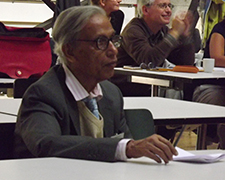
Professor Nirmal C. Sukul
Professor Nirmal C. Sukul, PhD, President of the Sukul Institute of Homeopathic Research (SIHR), is a senior scientist and academician with more than five decades of experience in research and higher education. He is a former Professor in the Department of Zoology and former Dean, Faculty of Science, Visva-Bharati University, Santiniketan, India.
Professor Sukul's long scientific career encompasses research in parasitology, neuropharmacology and high-dilution pharmacology. His work reflects an interdisciplinary approach, bringing together biological experimentation, pharmacological investigation and the scientific study of highly diluted preparations. Over the years, a major part of his research interest has been directed toward investigating the biological activity, physicochemical characteristics and possible mechanisms associated with homeopathic and high-dilution preparations.
Alongside his research in high dilutions, Professor Sukul has made substantial contributions to parasitology and neuropharmacology, providing a broader experimental foundation for his later investigations into homeopathic preparations. His scientific approach has emphasized the use of laboratory models and measurable biological parameters to investigate questions that lie at the interface of biology, pharmacology and high-dilution research.
An important dimension of Professor Sukul's academic career has been his contribution to research training and scientific mentorship. He has successfully supervised 32 PhD scholars, contributing to the development of several generations of researchers during his academic career. His role as a teacher, research supervisor and academic leader has therefore extended considerably beyond his individual research contributions.
For more than five decades, Professor Sukul has remained closely associated with the scientific investigation of homeopathy and high dilutions. His research has included experimental studies involving biological systems and physicochemical approaches, with the broader objective of examining whether highly diluted preparations can produce measurable effects and, where such effects are observed, exploring possible scientific explanations for them.
As President of SIHR, Professor Sukul continues to provide scientific guidance to the Institute's research and academic activities. His experience in university research, doctoral supervision and interdisciplinary investigation provides an important foundation for SIHR's continuing programme of laboratory-based research in homeopathy and high-dilution science.
He also serves as Editor-in-Chief of Clinical and Experimental Homeopathy, where his extensive experience in experimental research and academic supervision contributes to the journal's objective of encouraging rigorous scientific investigation, critical discussion and interdisciplinary research in homeopathy, high dilutions and related areas.

Professor Soma Sukul
Professor Soma Sukul, PhD, is associated with the Sukul Institute of Homeopathic Research (SIHR), Kolkata, India, as a Scientist and contributes to the Institute’s interdisciplinary research activities, particularly in areas connecting plant sciences, environmental biology and experimental homeopathy. She is currently Professor in the Department of Botany, Visva-Bharati University, Santiniketan, India, a Central University under the Government of India.
Professor Sukul is an experienced researcher and academician whose principal areas of research include agro-homeopathy, phytoremediation, plant diversity and ethnobotany. Her research interests reflect a broad approach to plant science, extending from the investigation of plant responses under experimental conditions to the study of plants in relation to environmental remediation, biodiversity, traditional knowledge and their wider biological significance.
A particularly relevant area of her research is agro-homeopathy, involving experimental investigation of homeopathic and highly diluted preparations in plant systems. Plant-based experimental models offer opportunities to study measurable biological parameters under controlled conditions and can contribute to systematic investigation of the effects associated with highly diluted preparations. Her expertise in botany therefore provides an important plant-science dimension to the interdisciplinary research programme of SIHR.
Her work in phytoremediation explores the potential role of plants in relation to environmental contaminants and ecosystem restoration, while her research on plant diversity and ethnobotany encompasses the documentation and scientific study of plant resources, biodiversity and traditional knowledge associated with the use of plants. Together, these areas demonstrate the breadth of her research across fundamental, applied and environmental plant sciences.
Professor Sukul is also actively engaged in postgraduate teaching, doctoral research and scientific mentorship. PhD scholars working under her supervision conduct research in her laboratory in areas related to her principal fields of expertise. Through the supervision of doctoral researchers, she contributes to the training of young scientists in experimental design, laboratory investigation, field-based botanical research, analysis and scientific communication.
Her association with SIHR adds an important botanical and plant-experimental component to the Institute's research activities. Her expertise is particularly relevant to developing experimental plant models for investigating high dilutions, thereby complementing SIHR's work involving biological, pharmacological and physicochemical approaches.
Professor Sukul also contributes to the broader academic objective of encouraging collaboration between botany, environmental science, pharmacology, high-dilution research and homeopathy. Such interdisciplinary interaction is particularly valuable in designing experiments capable of generating measurable and reproducible observations while exploring scientific questions concerning highly diluted preparations.
Through her combined roles as a university professor, research supervisor and Scientist associated with SIHR, Professor Soma Sukul contributes to the Institute's objective of promoting rigorous laboratory-based and interdisciplinary research and strengthening the participation of plant sciences in experimental homeopathy and high-dilution research.